Last Updated: August 2026
Your crawl space is probably one of the last places you think about when it comes to home maintenance.
It’s dark, difficult to access, and usually hidden behind a small door somewhere you rarely open. But that doesn’t mean nothing is happening down there.
Crawl spaces can accumulate moisture from bare soil, groundwater, condensation, leaks, and humid outdoor air. When that moisture sticks around, it can create an environment where mold can grow and can contribute to moisture-related problems elsewhere in the home. The U.S. Environmental Protection Agency specifically identifies crawl spaces with high relative humidity as common locations for hidden mold growth.
So, do you actually need a dehumidifier down there?
Not necessarily.
A dehumidifier isn’t automatically the answer to every crawl-space moisture problem. In some situations, the real issue may be a plumbing leak, poor drainage, groundwater intrusion, or moisture coming through an uncovered dirt floor.
But if you’ve addressed the obvious sources of water and your crawl space is still consistently humid, a dedicated dehumidifier can be an important part of your moisture-control strategy.
Here’s how to determine whether you actually need one.
The Short Answer
You should seriously consider a crawl-space dehumidifier if your space has consistently high humidity, condensation, musty odors, visible mold, damp insulation, or recurring moisture problems that aren’t being solved by fixing leaks and improving drainage.
The EPA recommends keeping indoor relative humidity below 60%, ideally between 30% and 50%, because excessive humidity can contribute to mold growth.
However, don’t immediately buy a dehumidifier just because you notice moisture.
First, find out where the moisture is coming from.
A dehumidifier removes moisture from the air. It doesn’t repair a leaking foundation, stop groundwater from entering your crawl space, or fix a broken pipe.
That distinction can save you a lot of money.
Why Do Crawl Spaces Get So Humid?
Crawl spaces are particularly vulnerable to moisture because of their location and construction.
According to the EPA, moisture can enter crawl spaces through several pathways, including bare soil, groundwater, and other sources of water intrusion. In a crawl space with a bare-earth floor, moisture from the soil can evaporate into the air and increase humidity.
Some of the most common sources include:
Bare or Uncovered Soil
Dirt floors can allow moisture from the ground to enter the crawl space as water vapor.
Groundwater
Homes in areas with high water tables may experience groundwater entering or accumulating in crawl spaces.
Plumbing Leaks
Even a relatively small leak can continuously introduce moisture into an enclosed area.
Poor Drainage
Water that isn’t properly directed away from the home’s foundation can eventually contribute to basement and crawl-space moisture problems.
Condensation
Warm, humid air meeting cooler surfaces can create condensation, adding even more moisture to the environment.
Humid Outdoor Air
Depending on the climate and crawl-space design, outside air can introduce significant moisture.
This is why simply opening vents isn’t always the solution. Bringing humid outdoor air into an already moisture-prone crawl space can sometimes make the situation worse.
7 Signs Your Crawl Space May Need a Dehumidifier
You don’t need to crawl underneath your house every day with a humidity meter.
There are several clues that can tell you something may be wrong.
1. The Humidity Stays High
This is the biggest indicator.
If you’ve measured the relative humidity and it regularly remains above 60%, that’s a reason to investigate further.
The EPA recommends keeping indoor relative humidity below 60%, with an ideal range of 30%–50% where possible.
For a crawl space, consistently elevated humidity deserves attention because the area may contain wood framing, insulation, stored materials, and other surfaces that can be affected by persistent moisture.
A basic hygrometer can help you determine whether you actually have a humidity problem rather than relying on guesswork.
2. You Notice a Musty Smell
A musty smell coming from a crawl space shouldn’t simply be dismissed as “that’s what crawl spaces smell like.”
It can indicate that moisture has been present for some time.
The smell itself doesn’t tell you exactly where the moisture is coming from, but it’s a good reason to inspect the space for damp materials, condensation, leaks, standing water, or visible mold.
3. You See Condensation
Water droplets appearing on pipes, ducts, insulation, or other surfaces can indicate that humidity is high enough for moisture to condense on cooler surfaces.
Condensation is particularly important because it means water is no longer just present as invisible vapor in the air.
If you’re repeatedly seeing condensation, investigate the humidity level and the conditions causing it rather than simply wiping the surface.
4. You Find Mold or Mildew
Mold requires moisture to grow.
The EPA notes that mold can grow on many organic materials when moisture and oxygen are present, and controlling indoor moisture is an important part of controlling mold growth.
If you discover mold in your crawl space, don’t assume that purchasing a dehumidifier alone solves the problem.
The moisture source needs to be addressed, and existing mold may require appropriate cleaning or professional remediation depending on the extent of the problem.
5. Insulation or Wood Looks Damp
Take a close look at exposed insulation, floor joists, beams, and other materials.
Persistent dampness can indicate that the crawl space isn’t maintaining appropriate moisture conditions.
The goal isn’t simply to make the space “feel dry.” It’s to create an environment where moisture doesn’t continually accumulate.
6. Your Basement or Home Has Recurring Moisture Problems
Crawl-space moisture doesn’t necessarily stay confined to the crawl space.
The EPA notes that moisture accumulating in crawl spaces can enter other parts of a building through cracks and openings in walls, floors, and ceilings.
If you repeatedly notice dampness, musty odors, or elevated humidity in the areas above or adjacent to the crawl space, it’s worth investigating what’s happening underneath.
7. You’re Constantly Fighting Humidity Despite Fixing Obvious Problems
This is perhaps the strongest case for a dehumidifier.
If you’ve already:
- Fixed plumbing leaks
- Improved drainage
- Addressed standing water
- Checked the foundation
- Reduced obvious moisture entry
- Taken reasonable steps to control ground moisture
…and humidity remains consistently high, mechanical dehumidification may be the missing piece.
Do You Need a Dehumidifier or Do You Need to Fix the Crawl Space?
This is where many homeowners get it wrong.
A dehumidifier is not a cure for active water intrusion.
Imagine you have a foundation leak that’s putting water into the crawl space every time it rains.
Installing a dehumidifier might remove some of the resulting humidity, but the underlying problem is still there.
The EPA recommends addressing moisture sources such as leaks, seepage, and drainage problems rather than relying solely on humidity control.
So think of it this way:
Water coming in → fix the source.
Humidity remaining after moisture sources are controlled → consider dehumidification.
Sometimes you’ll need both.
What About a Vapor Barrier?
If your crawl space has a bare-earth floor, the ground itself can contribute moisture.
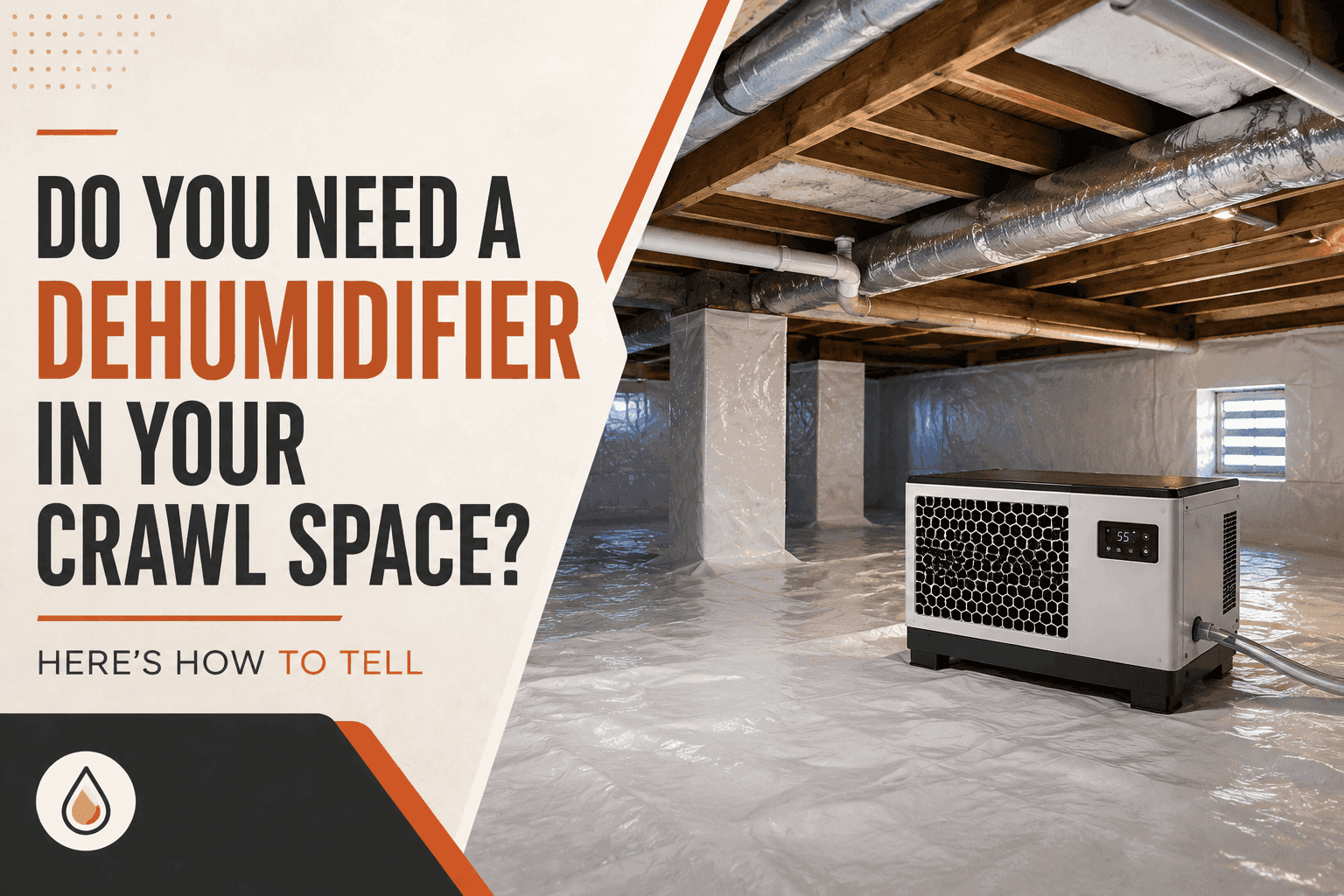
The EPA recommends using a plastic cover over dirt in crawl spaces as one method of reducing moisture entering from the ground.
That’s important because a dehumidifier shouldn’t be expected to fight an unlimited moisture load coming from the soil.
A proper crawl-space moisture-control strategy may involve multiple measures, such as:
- Ground moisture control
- Drainage improvements
- Leak repairs
- Appropriate ventilation or conditioning
- Air sealing where appropriate
- Dehumidification
The right combination depends on the construction of the crawl space and the source of the moisture.
How Do You Know How Humid Your Crawl Space Is?
Don’t guess.
Buy an inexpensive digital hygrometer and monitor the relative humidity.
This is one of the simplest ways to determine whether you’re dealing with an actual humidity problem.
The EPA recommends keeping indoor relative humidity below 60%, ideally between 30% and 50%.
For a crawl space, I’d pay more attention to consistently elevated readings than a single reading taken on one afternoon.
Humidity can naturally fluctuate with weather, temperature, and seasonal conditions.
If your crawl space repeatedly sits at high humidity, that’s much more meaningful than seeing one unusually high reading.
What Humidity Level Should a Crawl Space Have?
There’s no reason to aim for an extremely dry crawl space.
In general, keeping relative humidity below 60% is a sensible moisture-control target, with the EPA identifying 30%–50% as an ideal indoor range where possible.
Some building guidance specifically discusses controlling crawl-space humidity below 65% using ventilation or dehumidification depending on conditions.
The important takeaway isn’t chasing one magic number.
It’s preventing the crawl space from remaining excessively humid for extended periods.
When Does a Dehumidifier Make Sense?
A dedicated dehumidifier becomes particularly useful when:
Your crawl space stays humid
Even after addressing obvious moisture sources.
The climate is naturally humid
Warm, humid outdoor conditions can make moisture control more difficult.
The crawl space has limited natural drying
An enclosed or conditioned crawl space may benefit from mechanical moisture removal.
You have recurring condensation
A dehumidifier can help reduce the amount of water vapor available to condense.
You’re trying to protect moisture-sensitive materials
Controlling humidity can help reduce the conditions that contribute to mold and moisture-related deterioration.
You want consistent humidity control
Unlike occasional ventilation, a properly configured dehumidifier can actively remove moisture when humidity rises.
The EPA itself recommends dehumidifiers as one method of reducing moisture in humid environments.
What Should You Look for in a Crawl-Space Dehumidifier?
Not every dehumidifier is designed for crawl-space use.
Before buying one, pay attention to these factors.
1. Coverage Area
Start with the size of your crawl space.
A unit that’s too small may struggle to keep up with the moisture load.
A unit that’s significantly larger than necessary may cost more than you need to spend.
Argendon’s current lineup, for example, ranges from models rated around 1,000 square feet to larger units rated for 1,800, 2,300, and more depending on the model.
2. Moisture-Removal Capacity
Don’t compare dehumidifiers solely by the largest “pints per day” number you see.
Pay attention to the AHAM rating as well as saturation capacity because these represent different testing conditions.
For example, Argendon’s Shield 35M is currently listed at 35 pints/day AHAM and 70 pints/day saturation.
3. Drainage
This is a huge consideration for crawl spaces.
You don’t want to crawl underneath your house every day to empty a bucket.
Look for a model that supports continuous drainage.
Gravity drainage can work well when the drain is positioned correctly.
If your drainage point is higher than the dehumidifier, a unit with a condensate pump may be a much better choice.
4. Operating Temperature
Crawl spaces can get much cooler than the rooms above them.
Look for a model that can operate effectively at the temperatures your crawl space actually experiences.
Auto-defrost is also useful in cooler conditions.
For example, Argendon lists the Shield 35M’s operating range as 33°F–105°F and includes automatic defrost.
5. Noise
Noise may not matter much if the crawl space is completely isolated.
But if your basement is finished or located directly beneath frequently used rooms, it’s worth checking the manufacturer’s published noise rating.
The Shield 35M, for example, is listed at 50 dBA.
6. Filter Maintenance
A removable filter makes routine maintenance easier.
Whatever model you choose, make sure you’re comfortable cleaning or replacing its filter according to the manufacturer’s instructions.
A dirty filter can reduce airflow and affect performance.
7. Warranty
A crawl-space dehumidifier may operate for long periods, so warranty coverage is worth considering.
The current Shield 35M listing includes a limited 5-year warranty.
Do You Need a Crawl-Space-Specific Dehumidifier?
Not always.
But there are good reasons to consider one.
Crawl spaces can be more demanding environments than bedrooms or living rooms. They may have:
- Higher humidity
- Lower temperatures
- Limited access
- Poor airflow
- Dust and debris
- Difficult drainage
A purpose-built unit can therefore be easier to install and operate continuously in this type of environment.
That doesn’t mean every homeowner needs an expensive commercial machine.
It means you should choose based on the conditions of your actual crawl space, not simply the room size printed on a box.
One Example: Argendon Shield 35M
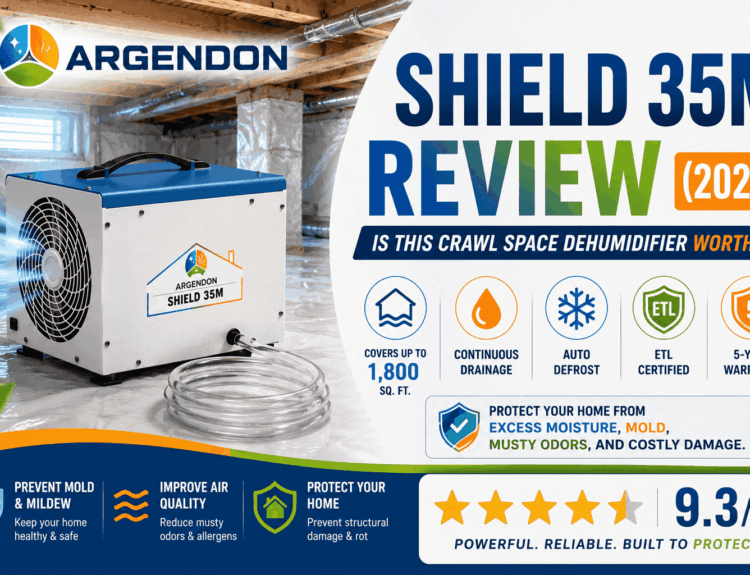
If you’ve determined that you need dedicated dehumidification, the Argendon Shield 35M is one model worth considering for smaller crawl spaces and basements.
Argendon currently lists it for spaces up to 1,000 square feet, with a 35-pint AHAM moisture-removal capacity and 70-pint saturation capacity. It also provides 115 CFM airflow, automatic defrost, adjustable humidity settings, and gravity drainage.
Its compact dimensions—approximately 15.35 × 11.2 × 11.4 inches—also make it easier to position in confined areas.
One thing to pay attention to is the drainage setup.
The Shield 35M uses gravity drainage, so you’ll need a suitable drain location. If gravity drainage isn’t practical in your crawl space, Argendon’s Shield 35P offers both gravity drainage and a built-in condensate pump capable of sending water up to 19.6 feet.
We’ve already taken a much closer look at the Shield 35M in our dedicated review:
Argendon Shield 35M Review: Is This Crawl Space Dehumidifier Worth Buying?
That article goes into the unit’s specifications, drainage, controls, operating temperature, maintenance, and overall value in considerably more detail.
Shield 35M vs Shield 35P: Which Makes More Sense?
If you’re considering one of these two models, the biggest difference is drainage.
| Feature | Shield 35M | Shield 35P |
|---|---|---|
| AHAM Capacity | 35 pints/day | 35 pints/day |
| Saturation Capacity | 70 pints/day | 70 pints/day |
| Coverage | Up to 1,000 sq. ft. | Up to 1,000 sq. ft. |
| Gravity Drain | Yes | Yes |
| Built-In Pump | No | Yes |
| Auto Defrost | Yes | Yes |
| Airflow | 115 CFM | 115 CFM |
| Best For | Suitable gravity-drain installations | Locations needing pumped drainage |
The 35M is the simpler option if you have an appropriate floor-level drain.
The 35P makes more sense if water needs to be pumped upward or to a more distant drainage point. Argendon specifies up to 19.6 feet of pump drainage for the 35P.
What If You Don’t Need a Dehumidifier?
This is just as important as knowing when you do.
If your crawl space has normal humidity and no signs of persistent moisture, you may not need to spend hundreds of dollars on a dedicated dehumidifier.
Instead, focus on regular inspection and moisture prevention.
That can include:
- Keeping gutters and downspouts functioning properly
- Directing rainwater away from the foundation
- Fixing plumbing leaks quickly
- Checking for standing water
- Monitoring humidity
- Addressing condensation
- Maintaining appropriate ground moisture control
The EPA specifically recommends fixing leaks and seepage and addressing drainage around the foundation as part of moisture control.
In other words:
Don’t buy a dehumidifier to compensate for a problem that should be repaired.
Common Crawl-Space Dehumidifier Mistakes
Buying Based Only on Square Footage
Two crawl spaces of the same size can have very different moisture loads.
Climate, groundwater, construction, ventilation, and existing moisture problems all matter.
Ignoring the Drain
A dehumidifier can collect a surprising amount of water.
Plan the drainage before installation.
Choosing a Unit That’s Too Small
If the unit can’t keep up with the moisture load, it may run continuously without achieving the humidity level you want.
Assuming a Dehumidifier Fixes Mold
It helps control one of the conditions that allows mold to grow, but existing mold still needs to be appropriately addressed.
Ignoring the Source of Moisture
If water is actively entering your crawl space, deal with that first.
Never Checking the Unit
Filters, drain lines, and the surrounding area still need periodic inspection and maintenance.
So, Do You Actually Need One?
Here’s the simplest way to think about it.
- Humidity consistently stays high
- You regularly see condensation
- The crawl space smells musty
- You have recurring moisture problems
- Mold keeps appearing
- The crawl space remains damp despite addressing obvious water sources
- You live in a persistently humid climate
- You want active, continuous humidity control
- Your crawl space is consistently dry
- Humidity remains under control
- There are no recurring condensation problems
- There are no unexplained musty odors
- There are no moisture-related issues
- Your existing moisture-control measures are working
And if you’re still unsure, measure the humidity first. A hygrometer can tell you considerably more than a guess.
Frequently Asked Questions
What humidity level is too high for a crawl space?
The EPA recommends keeping indoor relative humidity below 60%, with 30%–50% being an ideal range where possible. Persistently high humidity in a crawl space deserves investigation.
Can a dehumidifier prevent mold in a crawl space?
A dehumidifier can help control the moisture conditions that support mold growth, but it cannot guarantee that mold will never develop. Existing water leaks, condensation, and other moisture sources should also be addressed.
Is a dehumidifier enough for a damp crawl space?
Not necessarily. If groundwater, leaks, or moisture coming through the ground are the underlying problem, those sources should be addressed as well. A dehumidifier is best viewed as part of a broader moisture-control strategy.
Should I run a crawl-space dehumidifier continuously?
That depends on the humidity level, moisture load, and the unit’s controls. Many dedicated units can operate automatically based on humidity settings, allowing them to run when needed rather than necessarily operating continuously.
Can I use a regular household dehumidifier in a crawl space?
It depends on the unit and the conditions. Crawl spaces can be cooler, dustier, and more difficult to access than normal living spaces, so check the manufacturer’s specified operating temperature, installation requirements, drainage method, and intended use before placing a household unit there.
Does a crawl-space dehumidifier need a drain?
Not necessarily, but continuous drainage is highly convenient. Without it, you may need to empty the collection tank regularly. Gravity drainage works when the drain is positioned appropriately, while models with condensate pumps provide more installation flexibility.
Is the Argendon Shield 35M good for a crawl space?
The Shield 35M is specifically marketed for crawl spaces and basements and is currently rated for areas up to 1,000 square feet. It provides 35-pint AHAM capacity, 70-pint saturation capacity, auto-defrost, and gravity drainage.
What’s the difference between the Argendon Shield 35M and 35P?
Both models are currently rated for up to 1,000 square feet and have 35-pint AHAM/70-pint saturation capacity. The key difference is drainage: the 35M uses gravity drainage, while the 35P adds a built-in condensate pump.
Should I buy a dehumidifier if my crawl space has standing water?
Not as the first step. Standing water indicates a moisture-entry or drainage problem that should be investigated and corrected. A dehumidifier can help with humidity afterward, but it isn’t a substitute for fixing the source.
Final Verdict
Do you need a dehumidifier in your crawl space?
Maybe—but don’t start with the shopping cart.
Start with a humidity reading and a moisture inspection.
If your crawl space is consistently humid, has condensation or musty odors, or continues to experience elevated moisture after you’ve addressed leaks and drainage problems, a dedicated dehumidifier can make a lot of sense.
The goal isn’t to make your crawl space bone-dry.
The goal is to keep moisture under control consistently.
For homeowners with a crawl space of up to around 1,000 square feet, a compact unit such as the Argendon Shield 35M is one option to consider. Its current specifications include 35-pint AHAM capacity, 70-pint saturation capacity, 115 CFM airflow, auto-defrost, and gravity drainage.
If your installation requires pumped drainage, the Shield 35P offers that additional flexibility.
But whichever model you choose, remember the most important part:
A dehumidifier manages humidity. It doesn’t fix the reason water is getting into your crawl space.
Fix the moisture source first. Then let the dehumidifier handle what’s left.